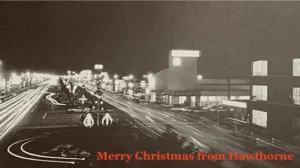



August — the middle of summer — that is, the way summer used to be. Kids were out of school (mostly); activities moved outdoors. There were excursions, like a trip to the Natural History Museum or the La Brea Tar Pits, maybe a day at Marineland of the Pacific. There were swimming lessons at the Hawthorne Municipal Swimming Pool. August was the prime month for family vacations – traditionally, the two-week paid absence that the head-of-household received as a benefit from his employer.

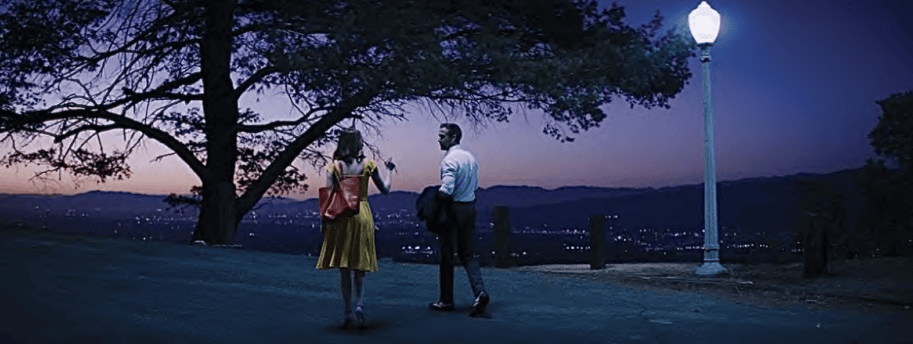
A lot of things happened outside between sundown and bedtime, especially if the day had been hot. Children played hide-and-seek in the neighborhood until the streetlights left deep shadows that made the hiders too hard for the seeker to find. Taller youngsters might stage an impromptu ping-pong tournament in the garage with the door open. Group picnics (church- or community-) would begin late in the day and continue until stars came out in the cooler sky. Night baseball games – Middle League, if not Little League – invited fans to linger in the bleachers, comfortable in short sleeves. Attending a night game at Dodger Stadium was a summer highlight.
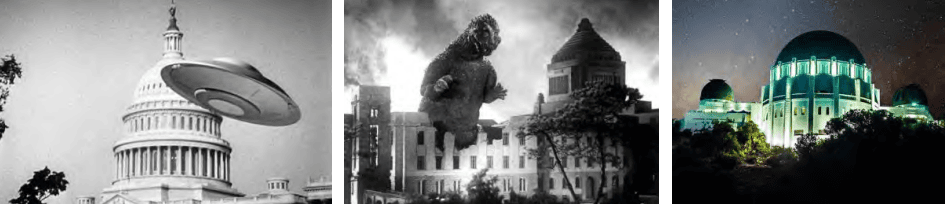
Summer movies were always something to wait for, long before they were one continuous variation on the superhero theme or the computer-animated movies for children with the hook for adults. Even better if they were seen at a local drive-in theatre in days when the flying saucerand monster schlock ruled. An evening visit to the Griffith Observatory would prove that real astronomical wonders were just as exciting as sci-fi movies. There were great rock concerts in outdoor venues (hold up your lighter and wave it in rhythm). For some, square dancing in a dance hall with the doors and windows open wide to the evening breeze filled the bill. For others, a poolside, tiki-themed luau was a little inkling of paradise.

Times and tastes have changed. Today in Hawthorne, the first full day of school is August 19th or 20th, five weeks before the official end of summer. A two-week vacation where your employer can’t reach you by cell phone? Really?
Don’t worry, we’ll find a way to make it a great summer.
A few of us can remember the burnt citrus smell carried on the smoke blowing from the burning mounds of grubbed-up orange trees to our cars as we rode along the yet-to-be connected segment of the “Santa Ana Freeway,” now the I-5 in Orange County. The dense groves were giving way to a landscape of tract houses and eventually, a patchwork of cities in that inland portion of Southern California, thirty miles southeast of the Los Angeles metropolis. In Anaheim, a city founded as a vineyard colony by an association of German immigrants almost a century earlier, the orange groves near Harbor Blvd and Katella Ave were reduced to ashes for the dreams of a famous, imaginative man – dreams that would start a cultural revolution in the world of entertainment. Through the next seventy years, Disneyland became a lifetime experience for many of our members.
Walt Disney was born just before the 20th century was two years old. He grew up in small-town America – Marceline, MO, to be exact – where a talent for drawing and an interest in art started to shape the rest of his life. He made drawing and illustrating his mode of work, though it was not always steady. He was introduced to, and began to work on cartoon film animation. He experimented at home and in 1921, thought (wrongly, it proved) that he could then make a viable business of it. He moved to Hollywood, CA in 1923, followed by brother Roy, and they tried again. They founded a studio in Burbank in 1926, but soon lost the rights to their successful cartoon character, Oswald the Rabbit, in a dispute with the series producer. Walt saved the business by inventing a new character just as the movie industry was marrying sound to moving images. Mickey Mouse was a hit in 1928 and was Walt’s partner for the remainder of his career; he always paid tribute to their relationship. In the next twenty-plus years, he and his select team of gifted people made innovations in animation and film that became standards in American- and world culture.
People visiting Southern California wanted to include Walt Disney Studios in their itinerary – not easy for a busy factory to accommodate. Walt recalled the fun of taking his daughters to Griffith Park and the impression that world-famous Tivoli Gardens had made on him during a family visit to Copenhagen, Denmark. In the late 1940s, he acquired land adjacent to the studio for developing an amusement park that would add to the experience of a studio tour. He hired professionals- artists, designers, ride builders and others to plan the park and associate it with the beloved Disney characters and films. In 1952, as the ideas blossomed and the projects took shape, they realized that they were creating a concept much larger than the plot they had reserved for it. Development experts working for Walt found a 160 acre parcel of abandoned orange groves in Orange County that their research said would be an ideal site for this innovation in entertainment and the purchase was made.
The expected cost for the construction of the park exceeded the amount Bank of America was prepared to venture and along with the personal assets Walt poured into the project, the offshoot Disney subsidiary partnered with ABC-Paramount and Western Publishing, both of whom had worked with the Studio, to supply the required capital. Construction began in 1954 and a June opening the next year was delayed by setbacks until July 17, 1955. Glitches even invaded a special live telecast of the opening on the ABC Network, hosted by Bob Cummings, Art Linkletter, Ronald Reagan and Walt, himself. Things went better the next day and with only a few incidents, ever since. Around 28,000 people are believed to have attended the first day and 1 million by the end of the year.
In parallel with the lives of Hawthornians, Disneyland has grown and evolved into a landmark notably different from its form at birth, but like us, some of the rides, attractions and features from the original are still recognizable in the present body of the park. If your lifespan overlaps that of Disneyland, you will remember – perhaps fondly – some of the features that have disappeared or that have been replaced by newer attractions as the managers have sought to make the park relevant to younger generations who have loved more recent creations of the Disney media world.
The original configuration had Disneyland divided into five themed sections: Main Street USA, Adventureland, Frontierland, Fantasyland, Tomorrowland. New Orleans Square was added in 1966, Bear Country – now Bayou Country, in 1972 and the vast transformation of the original parking lot and Disneyland Hotel into Disney California Adventure, Downtown Disneyland and Disney’s Grand Californian Hotel & Spa was finished in 1990. Original Disneyland became “Disneyland Park.” Mickey’s Toontown arrived in 1993 and Star Wars: Galaxy’s Edge touched down in 2019.
As new sections were developed, some of the earlier rides, attractions and exhibits were displaced. Walt died in 1966 and while his family continued to direct the growth of Disneyland for some time, the rapidly expanding business ultimately came into the hands of new corporate leadership and association with other media enterprises and creatives sources (Lucasfilm, Pixar). Though the concept has proliferated around the world, the first-of-its-kind theme park in Southern California is still one of the most popular entertainment destinations anywhere.
Nearby Hawthornians who grew up with the Park just down the freeway have the distinction of remembering, pleasantly, “things that aren’t there anymore.” Here are some you might have enjoyed and now miss:

along Main Street, USA
the Shooting Gallery, 1955 – 1962
in Adventureland
the Big Game Safari Shooting Gallery, 1962 – 1982
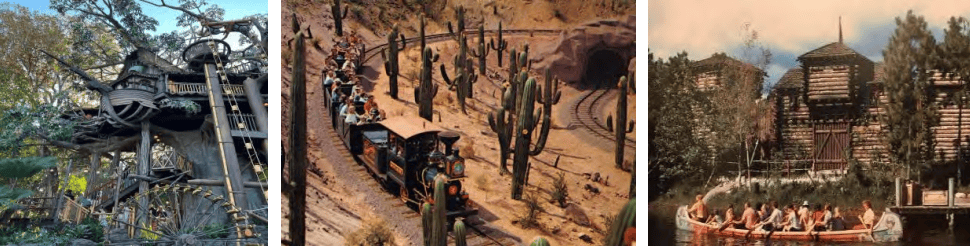
the Swiss Family Robinson Treehouse, 1962 – 1999
in Frontierland
Pack Mules / Rainbow Ridge Pack Mules / Pack Mules Through Nature’s Wonderland,
1955 – 1973
the Stage Coach / Rainbow Mountain Stage Coach, 1955 – 1960
the Rainbow Cavern Mine Train, 1955 – 1959 / Mine Train Through Nature’s Wonderland, 1960 – 1977
Indian War Canoes, 1956 – 1971 – now Davy Crockett’s Explorer Canoes
Indian Village, 1955 – 1971; both now in Bayou Country
Mike Fink’s Keel Boats, 1956 – 1991; 1996 – 1997
in Bayou Country
Splash Mountain, 1989 – 2023

in Fantasyland
Skyway to Tomorrowland, 1956 – 1994
Junior Autopia / Midget Autopia / Fantasyland Autopia, 1956 – 1966
Skull Rock and Pirate’s Cove with Capt. Hook’s pirate ship, “Chicken of the Sea” > “the Jolly Roger,” 1955 – 1982
in Mickey’s Toontown
Jolly Trolley, 1993 – 2003
Chip ‘n Dale’s Treehouse, 1998 – 2020

in Tomorrowland
Clock of the World, 1955 – 1960
Rocket to the Moon, 1955 – 1966, refurbished as Flight to the Moon, 1967 – 1975, then, Mission to Mars, 1975 – 1992
20,000 Leagues Under the Sea (walk-through movie sets), 1955 – 1966
Astro Jets, 1955 – 1964 > Tomorrowland Jets, 1964 – 1966
Skyway to Fantasyland, 1956 – 1994

Viewliner Train of Tomorrow, 1957 – 1958
Monsanto House of the Future, 1957 – 1967
Submarine Voyage, 1959 – 1998, returning as Finding Nemo Submarine Voyage, 2007
Flying Saucers, 1960 – 1966
People Mover, 1967 – 1995
Tomorrowland Autopia, 1955 – 1999, now Autopia, opened 2000
Star Tours, 1987 – 2010


There were many more. Great old rides and attractions remind you of the fun you had at the realization of Walt Disney’s dream. Changes invite you to keep coming back for more fun. And why not? It’s just down the freeway . . .